Project Zenith and AMD Ryzen AI Halo
Windows Finally Gets a Serious Local AI Developer PC
For the past two years, the phrase "AI PC" has mostly meant a normal laptop with an NPU, a Copilot key and a collection of features that could also have run in the cloud. Microsoft's Project Zenith and AMD's new Ryzen AI Halo hardware point towards something much more interesting, a Windows development machine designed to run substantial AI models locally as part of an everyday engineering workflow.
This is an important distinction. Project Zenith has already been described in some coverage as a new or stripped down version of Windows 11. Microsoft's own announcement is more precise. It calls Zenith a "ready to code" Windows 11 experience for developer class devices, with a preconfigured toolchain, developer friendly defaults and hardware capable of running large models locally. Microsoft has not announced a separate Windows edition, downloadable ISO or replacement for Windows 11 Pro. The first hardware platform will be AMD Ryzen AI Halo. This is AMD's new branded AI developer mini-PC, rather than simply another name for a processor generation. It pairs high end Ryzen AI compute with 128 GB of unified memory, full ROCm support and a choice of Windows or Linux. The result sits somewhere between a powerful workstation, a local inference server and the sort of developer box that would previously have lived in a cloud subscription. The software and hardware announcements make far more sense together than they do separately. Microsoft is defining what a Windows machine for local AI development should feel like. AMD is supplying a compact system with enough shared memory to make that experience useful.
Project Zenith is a Windows developer experience
Microsoft introduced the ideas behind Zenith at Build 2026 and formally announced the project in September. A qualifying device needs at least 64 GB of unified memory and more than 250 GB/s of memory bandwidth. Microsoft says these systems can run models with more than 30 billion parameters locally and without metered token charges. Those requirements tell us more about Zenith than the preinstalled applications do. This is not an attempt to put Copilot on another category of consumer PC. Microsoft is defining a class of machine for developers who want local coding models, agent runtimes and AI-assisted applications operating alongside their normal development stack.
The Windows setup arrives with the tools most developers would install during their first few hours with a new machine. Microsoft explicitly names Windows Terminal and Visual Studio Code, while the wider toolset shown with the announcement includes GitHub Copilot, PowerToys, WinAppCLI, Windows Dev Skills, PowerShell 7, Git, GitHub CLI, Azure CLI, Python, Node.js, WSL with Ubuntu and .NET 10. Its also configured with sensible engineering defaults. File extensions, hidden files and the full path are visible in File Explorer. Long path support is enabled. Recent file suggestions, sync provider tips, Start menu promotions and account notifications are reduced or disabled. The PowerToys Command Palette is available from the beginning. These are individually small changes, but together they remove a surprising amount of friction from setting up a Windows development environment.
The inclusion of WSL is particularly useful. Local AI tooling still tends to reach Linux first, especially around model serving, Python environments and GPU acceleration. A Windows machine that can move between .NET, native Windows applications and Linux based inference tooling without becoming two separate computers is a compelling proposition. Microsoft is also pushing WSL containers as a built in way to create and run Linux containers directly from Windows.
According to the official Project Zenith announcement, the environment remains customisable. Zenith provides the starting configuration rather than locking developers into Microsoft’s chosen editor, runtime or workflow.
Ryzen AI Halo is the hardware platform, not just a chip name
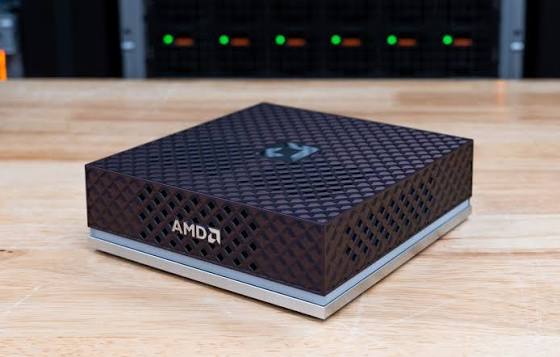
AMD Ryzen AI Halo is AMD's first branded AI developer platform: a compact mini-PC built specifically for local AI development. The current system uses a Ryzen AI Max+ 395 processor, 128 GB of LPDDR5X unified memory, integrated Radeon 8060S graphics and an NPU delivering up to 50 TOPS. AMD quotes up to 60 FP16 TFLOPS of GPU performance and supplies the machine with Windows 11 Pro or Linux. The distinction between the complete Halo machine and the processor inside it is worth preserving. Ryzen AI Halo is the system developers buy. Ryzen AI Max+ 395 is the processor powering the initial version. Reducing the product to an older silicon codename misses AMD's larger move into complete, validated developer hardware.
AMD has designed the system around its ROCm software stack and the frameworks developers already use, including PyTorch, vLLM, llama.cpp, Ollama, ComfyUI and LM Studio. The AMD Ryzen AI Developer Center provides access to validated configurations, playbooks, tools and updates. This is an attempt to sell a working development platform rather than hand developers a capable chip and leave them to assemble the software themselves. The AMD Ryzen AI Halo product page says the current 128 GB machine can run models containing as many as 200 billion parameters. A next generation version using the Ryzen AI Max+ PRO 495 and supporting 192 GB of unified memory is also marked as coming soon. AMD says that version will allow as much as 160 GB to be assigned as graphics memory. The initial system is listed at $3,999 in the United States and is being sold through Micro Center. AMD currently describes it as available for purchase and use in the US, so buyers elsewhere should not assume there is already an official local sales route. Microsoft has also said that Project Zenith will arrive on further devices from OEM and silicon partners, which should eventually make the concept broader than this first AMD box.
Unified memory is the real AI specification
The NPU number will attract attention because AI PCs have trained buyers to compare TOPS. For the workloads targeted by Ryzen AI Halo, memory is the more consequential specification. A model must fit somewhere before a CPU, GPU or NPU can run it. Conventional workstations divide system RAM and dedicated GPU memory into separate pools. A machine may have 128 GB of system memory while still being unable to load a model requiring more than the 16 GB or 24 GB attached to its graphics card. Moving data between those pools also adds overhead. Ryzen AI Halo's unified memory can be shared by the CPU and integrated GPU. That gives local inference workloads a much larger usable memory pool without requiring an extremely expensive discrete accelerator. It also explains Microsoft's 250 GB/s bandwidth requirement. Capacity allows the model to load; bandwidth has a major influence on how quickly inference can move through its weights.
This doesnt mean a $3,999 mini-PC suddenly performs like a rack of data centre GPUs. Parameter counts are also easy to misread. Whether a 120-billion or 200-billion parameter model fits depends on quantisation, context length, runtime overhead, model architecture and how much memory remains available to Windows and other applications. Fitting a model is only the first test. The generated tokens per second still need to be fast enough for the intended workflow. Microsoft's more conservative promise of capable 30B-plus models is then the better baseline for evaluating Zenith. Models in that range can support useful coding, retrieval, extraction and agent workloads while leaving enough headroom for an IDE, containers, databases and the rest of a real development environment.
Local AI changes the developer workflow
Most enterprise AI systems will continue to use cloud models. Frontier models improve rapidly, managed APIs remove infrastructure work, and cloud capacity can scale far beyond a desktop machine. Local AI adds another execution target rather than making those advantages disappear. The benefit is control over where each part of a workload runs. A coding agent can use a local model for repository navigation, classification, summarisation, test generation or repetitive tool decisions, then call a frontier cloud model for the difficult reasoning step. A document pipeline can perform initial extraction and redaction locally before sending a smaller, controlled payload to a hosted model. Developers can run large test suites without paying for every experimental prompt or placing source code in an external request. This hybrid approach also improves resilience. Local development can continue when a provider is rate limited, an API is unavailable or a team has exhausted its token budget. Models and prompts can be pinned for repeatable testing instead of silently changing beneath an evaluation. Sensitive prototypes can remain on the developer’s machine until the team has approved an external deployment path.
Agent development makes those economics more visible. A conventional chat request may involve one model call. An agent can make dozens or hundreds while planning, reading files, invoking tools, checking results and correcting itself. Microsoft argues that capable local models can absorb the continuous, lower value inference while frontier models remain available for frontier problems. The phrase is marketing friendly, but the architecture behind it is sound. Paying $3,999 upfront will not automatically cost less than using APIs. The calculation depends on utilisation, electricity, maintenance, model quality and developer time. A lightly used machine may never recover its cost. A team continuously running long agent sessions, evaluations or private inference could reach a very different result. Local inference also makes usage predictable: the marginal cost of another test run becomes close to zero once the hardware has been purchased.
Windows is becoming an agent host
The quieter part of the Zenith announcement may prove more important than the bundled tools. Microsoft says Zenith devices will benefit from its work on operating system enforced agent identity, Microsoft Execution Containers and enterprise manageability. Agents create a security problem that ordinary desktop applications do not fully capture. They can interpret untrusted content, decide which tool to call and perform a sequence of actions that was not written explicitly by a developer. Giving an agent the same identity, filesystem access and network permissions as its user is convenient during a demo and uncomfortable everywhere else. OS-enforced identities could allow each agent to operate as a distinct principal. Execution containers could constrain its files, processes and network access. Enterprise management could give organisations a consistent way to discover, configure and disable agents across a fleet. Microsoft has not yet supplied enough shipping detail to treat all of this as a finished security boundary, but placing it at operating system level is the right direction. Application libraries alone cannot reliably govern every agent and tool running on a developer workstation.
For .NET developers, this opens an interesting path. A local model server can sit beside an ASP.NET Core application, worker or Aspire environment without each experiment becoming a cloud infrastructure project. WSL can host Linux first model runtimes while Windows runs Visual Studio, SQL Server tooling and the rest of the Microsoft stack. If Microsoft exposes agent identity and containment through stable Windows APIs, .NET applications could participate in those controls rather than inventing their own local security model.
The software stack still has to prove itself
AMD hardware has not traditionally been the easiest route into local generative AI. Much of the ecosystem was built first around NVIDIA CUDA, and Windows support frequently arrived after Linux support. ROCm on Windows and integrated Radeon hardware has improved, but compatibility should be tested against the models, quantisation formats and runtimes a team intends to use. The presence of a Windows installer and a preconfigured application does not guarantee that every PyTorch extension, inference backend or fine tuning technique will perform identically across operating systems. Some workflows may still belong inside WSL or on the Linux image. Others may fall back to Vulkan or DirectML instead of using the most optimised ROCm path.
This is where the partnership between AMD and Microsoft becomes valuable. Zenith gives AMD a highly visible Windows target, while Ryzen AI Halo gives Microsoft hardware on which its local AI story can be tested against serious workloads. A validated combination of drivers, runtimes and developer tools can remove much of the uncertainty that has made local AI on PCs feel experimental. There are unanswered product questions too. Microsoft has not said whether Zenith will later be downloadable for existing qualifying PCs, offered through Windows setup, or remain an OEM factory configuration. It has not published final pricing for a Zenith equipped Halo device or confirmed whether current Ryzen AI Halo buyers will be able to add the complete Zenith experience themselves. Until Microsoft provides those details, buying the current Halo hardware and receiving Project Zenith should be treated as related decisions rather than assumed to be the same purchase.
A credible Windows AI workstation at last
Project Zenith will not transform every Windows developer into an AI engineer, and Ryzen AI Halo is too expensive and specialised to replace the ordinary development laptop. Together, however, they establish a credible new category. The interesting part is not that Windows ships with VS Code pinned to the taskbar. Developers can install a toolchain themselves. The advance comes from joining a calmer Windows configuration to hardware with enough unified memory and bandwidth to run useful models locally, then supporting it with WSL, ROCm and emerging operating system controls for agents. That combination changes local AI from an enthusiast setup into something an engineering team could evaluate as a standard development platform. It gives Windows developers a practical place to build hybrid AI systems, test agents without counting every token and keep selected workloads on the machine. It also creates meaningful competition for NVIDIA’s compact AI systems and Apple’s unified memory machines.
For years, the AI PC label has promised more intelligence without substantially changing what developers can run. Project Zenith and AMD Ryzen AI Halo finally push beyond that. They treat local models as part of the development environment itself, alongside the editor, terminal, containers and source control. That is a much stronger foundation for the next generation of Windows software than another Copilot button.
About the author
- Senior Software Engineer specialising in cloud architecture, distributed systems, and modern .NET development, with over two decades of experience designing and delivering enterprise platforms in financial, insurance, and high-scale commercial environments. My focus is on building systems that are reliable, scalable, and maintainable over the long term. I’ve led modernisation initiatives moving legacy platforms to cloud-native Azure architectures, designed high-throughput streaming solutions to eliminate performance bottlenecks, and implemented secure microservices environments using container-based deployment models and event-driven integration patterns. From an architecture perspective, I have strong practical experience applying approaches such as Vertical Slice Architecture, Domain-Driven Design, Clean Architecture, and Hexagonal Architecture. I’m particularly interested in modular system design that balances delivery speed with long-term sustainability, and I enjoy solving complex problems involving distributed workflows, performance optimisation, and system reliability. I enjoy mentoring engineers, contributing to architectural decisions, and helping teams simplify complex systems into clear, maintainable designs. I’m always open to connecting with other engineers, architects, and technology leaders working on modern cloud and distributed system challenges.
Comments
Join the discussionNo comments yet. Be the first to comment.