Your Distributed Lock Expired. Your Code Didn't.

A distributed lock can expire while the code that acquired it is still running. Another instance takes ownership, finishes its work and saves the result. Then the original instance resumes and overwrites it. The lock service can behave exactly as designed throughout that sequence. It grants a lease, lets it expire and grants another one. The failure happens because the application treats acquiring a lease as permission to keep writing for as long as its method takes to finish. In a .NET service, that assumption can hide behind a very reassuring await using block. The lifetime of the local object is visible in the code. The lifetime of the remote permission is somewhere else.
To protect shared state, the destination needs enough information to reject a worker whose ownership has been superseded. Fencing tokens provide that information. The useful part is understanding where they are issued, where they are checked and precisely what that check guarantees.
The worker that came back
Imagine a reporting service running across several containers. Each instance can rebuild a customer's report, but we want only one instance publishing that report at a time. We add a lease around the operation. This example uses an application defined lease abstraction, it isnt the API of a particular locking package.
public sealed class ReportRebuilder(
    IDistributedLeaseProvider leases,
    IReportBuilder builder,
    IReportRepository reports)
{
    public async Task RebuildAsync(
        Guid reportId,
        CancellationToken stopToken)
    {
        await using var lease = await leases.AcquireAsync(
            $"report:{reportId}",
            TimeSpan.FromSeconds(30),
            stopToken);

        var report = await builder.BuildAsync(reportId, stopToken);

        await reports.ReplaceAsync(reportId, report, stopToken);
    }
}
Instance A acquires the lease and starts building. It then stops making progress. For a reproducible example, suspend the process in a debugger. We dont need to assume that a particular garbage collection pause will last thirty seconds. After the lease expires, instance B acquires ownership, builds its report and publishes it. When A resumes, its next instruction is still there. Its local lease object still exists. Unless something actively prevents the write, A publishes too.
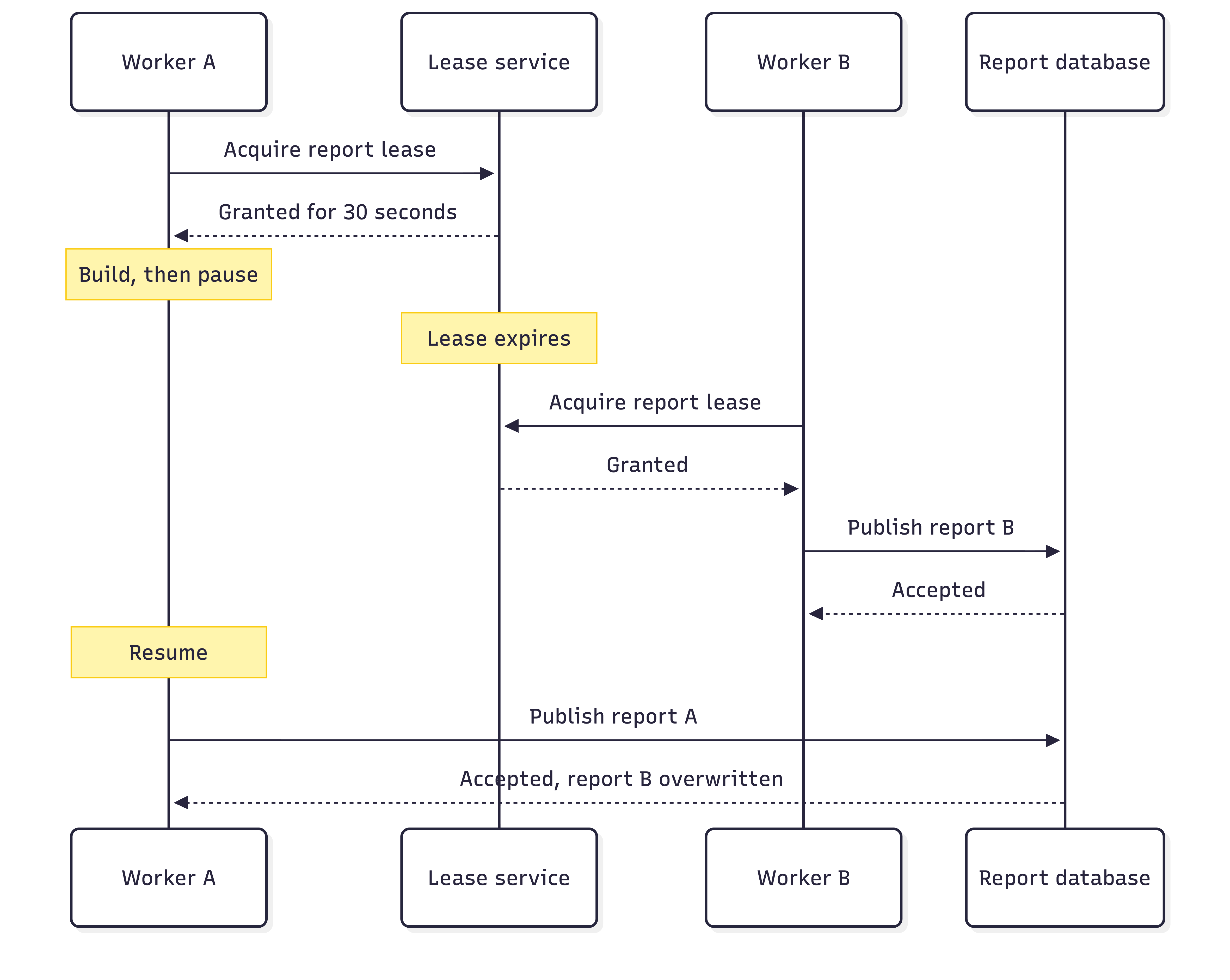
The important failure is a former owner continuing after ownership changes. A delayed request can cause the same problem even when the worker itself is no longer running. Martin Kleppmann's analysis of distributed locking explains why pauses and delayed writes must be considered when protecting a resource with a lease.
Renewal and cancellation
Renewing the lease is useful. If report generation takes a variable amount of time, renewal helps the current worker retain ownership while it makes progress. However, the renewal loop runs on infrastructure that can also stop making progress. A suspended process cannot reliably renew its lease or react to losing it. Redis's distributed locking documentation explicitly recommends fencing tokens and warns against assuming that a lease remains held while its original process is alive. Increasing the expiry moves the failure further away and increases recovery time after a crash. It doesnt give the destination any way to recognise a former owner. Cancellation still belongs in the implementation. When renewal fails, cancel ongoing computation and stop issuing new operations. In .NET, though, cancellation is cooperative. Requesting it cannot retract a write that another system has already accepted.
Even a check immediately before publishing leaves a gap:
stopToken.ThrowIfCancellationRequested();

await reports.ReplaceAsync(reportId, report, stopToken);
Ownership can change after that check. The report database needs to evaluate the worker's authority as part of accepting the mutation.
Give ownership a generation
A fencing token is an ordered ownership generation. One acquisition receives 41; the next receives 42. A worker includes its generation when accessing the protected resource, which enforces the ordering. In the common high water mark design, the destination remembers the largest generation it has accepted. After accepting 42, it rejects 41. Kleppmann describes this resource side check in the fencing section of his article.
A random owner identifier serves a different purpose: it identifies a particular acquisition, for example when deciding whether a release is allowed. It doesnt establish which acquisition came later. There is a subtle limit to the high water mark approach. If B acquires generation 42 but the destination still only knows about 41, an arriving write carrying 41 may still be accepted. Acquiring a newer generation elsewhere does not instantly update every protected resource. For our report publisher, we can make the handover stronger. The report already lives in SQL Server, so we'll keep its current ownership generation in the same row. Acquiring ownership changes that row immediately. Publication must match the generation currently stored there. This is an application specific design for publishing into one database. It avoids a separate lock service for this example and gives us a single place to order acquisition and publication.
Keep ownership beside the report
The row contains both coordination state and the published result. It is created when the report is provisioned, before workers attempt to acquire it.
CREATE TABLE dbo.ReportPublication
(
    ReportId uniqueidentifier NOT NULL
        CONSTRAINT PK_ReportPublication PRIMARY KEY,

    Generation bigint NOT NULL
        CONSTRAINT DF_ReportPublication_Generation DEFAULT (0),

    LeaseOwner uniqueidentifier NULL,
    LeaseUntilUtc datetime2(7) NULL,

    PublishedGeneration bigint NOT NULL
        CONSTRAINT DF_ReportPublication_PublishedGeneration DEFAULT (0),

    Payload nvarchar(max) NULL,
    PublishedAtUtc datetime2(7) NULL
);
Generation records the current ownership epoch. PublishedGeneration records which epoch supplied the visible result. They differ while a newly acquired worker is still building, and they can remain different if that worker fails. The previous report stays available during a rebuild. Taking ownership doesn't clear the payload. Acquisition increments the generation and installs an owner in a single conditional update:
UPDATE dbo.ReportPublication
SET Generation = Generation + 1,
    LeaseOwner = @owner,
    LeaseUntilUtc = DATEADD(second, @leaseSeconds, SYSUTCDATETIME())
OUTPUT inserted.Generation
WHERE ReportId = @reportId
  AND (
      LeaseUntilUtc IS NULL
      OR LeaseUntilUtc <= SYSUTCDATETIME()
  );
One returned value means the acquisition succeeded. No returned row means the report is missing or a lease currently prevents acquisition. A SQL exception is an operational failure and must not be converted into "lease busy". The generation increment belongs to the ownership transition. Allocating a number in the worker before acquiring ownership would allow allocation order and acquisition order to diverge. Generations only need to be ordered within the protected report. Report X and report Y can both be at generation 42. The counter must persist across releases, so releasing ownership must not delete this row or reset its generation.
Publish with a conditional write
Publication carries the exact acquisition identity back to the database:
UPDATE dbo.ReportPublication
SET Payload = @payload,
    PublishedGeneration = @generation,
    PublishedAtUtc = SYSUTCDATETIME()
WHERE ReportId = @reportId
  AND Generation = @generation
  AND LeaseOwner = @owner
  AND LeaseUntilUtc > SYSUTCDATETIME()
  AND PublishedGeneration < @generation;
The generation and owner conditions reject superseded workers. The expiry condition also refuses publication when the lease has already expired at the database's admission check. The final condition allows one publication per generation, preventing two competing results from the same acquisition from both being accepted. SQL Server evaluates the condition as part of the update. We dont load the row into application memory, check its generation and later issue an unconditional save. Microsoft's UPDATE reference documents the statement's filtering and locking behaviour. Both acquisition and publication modify the same existing row. If B's acquisition wins that ordering, A's publication no longer matches. If A's publication wins, it is ordered before B's acquisition. There is no successful publication by A after a committed handover to B. The expiry predicate is an admission check, not a promise that the transaction commits before a particular wall clock instant. We rely on the row's transactional ordering to protect the handover. Publication should remain a short database operation.
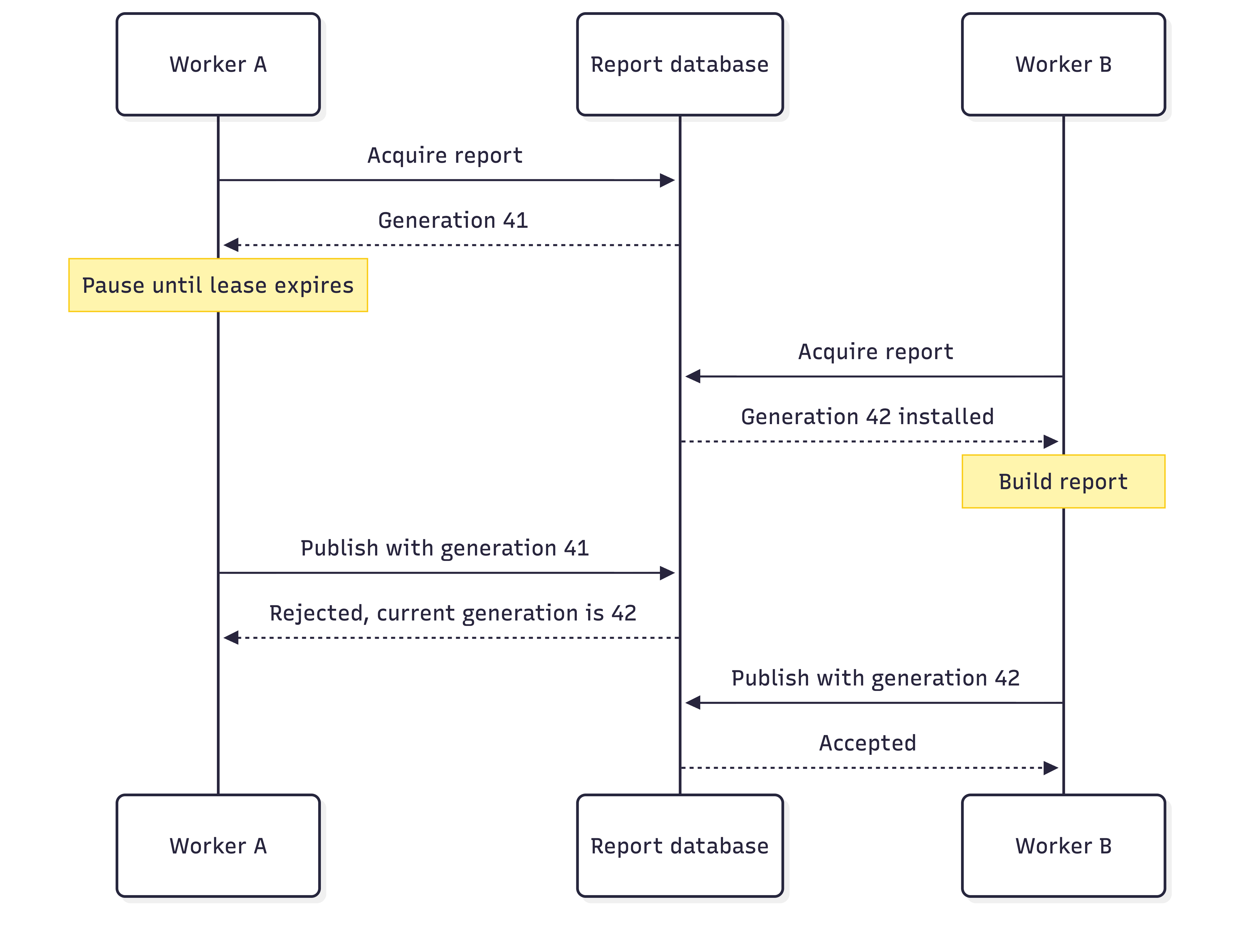
Notice that B doesnt need to have published anything before A is rejected. Its successful acquisition has already installed the fence.
Calling it from .NET
The following adapter targets SQL Server using Microsoft.Data.SqlClient. It assumes the table above, provisioned rows and no triggers that change affected row reporting. It deliberately uses short, autocommitted statements; report generation happens outside a database transaction.
using System.Data;
using Microsoft.Data.SqlClient;

public sealed record ReportLease(
    Guid ReportId,
    Guid Owner,
    long Generation);

public sealed class ReportPublicationStore(string connectionString)
{
    public async Task<ReportLease?> TryAcquireAsync(
        Guid reportId,
        int leaseSeconds,
        CancellationToken stopToken)
    {
        ArgumentOutOfRangeException.ThrowIfNegativeOrZero(leaseSeconds);
        var owner = Guid.NewGuid();

        await using var connection = new SqlConnection(connectionString);
        await connection.OpenAsync(stopToken);
        await using var command = connection.CreateCommand();

        command.CommandText = """
            UPDATE dbo.ReportPublication
            SET Generation = Generation + 1,
                LeaseOwner = @owner,
                LeaseUntilUtc = DATEADD(second, @leaseSeconds, SYSUTCDATETIME())
            OUTPUT inserted.Generation
            WHERE ReportId = @reportId
              AND (LeaseUntilUtc IS NULL OR LeaseUntilUtc <= SYSUTCDATETIME());
            """;

        command.Parameters.Add("@reportId", SqlDbType.UniqueIdentifier).Value = reportId;
        command.Parameters.Add("@owner", SqlDbType.UniqueIdentifier).Value = owner;
        command.Parameters.Add("@leaseSeconds", SqlDbType.Int).Value = leaseSeconds;

        var result = await command.ExecuteScalarAsync(stopToken);

        return result is long generation
            ? new ReportLease(reportId, owner, generation)
            : null;
    }

    public async Task<bool> TryPublishAsync(
        ReportLease lease,
        string payload,
        CancellationToken stopToken)
    {
        await using var connection = new SqlConnection(connectionString);
        await connection.OpenAsync(stopToken);
        await using var command = connection.CreateCommand();

        command.CommandText = """
            UPDATE dbo.ReportPublication
            SET Payload = @payload,
                PublishedGeneration = @generation,
                PublishedAtUtc = SYSUTCDATETIME()
            WHERE ReportId = @reportId
              AND Generation = @generation
              AND LeaseOwner = @owner
              AND LeaseUntilUtc > SYSUTCDATETIME()
              AND PublishedGeneration < @generation;
            """;

        AddLeaseParameters(command, lease);
        command.Parameters.Add("@payload", SqlDbType.NVarChar, -1).Value = payload;

        return await command.ExecuteNonQueryAsync(stopToken) == 1;
    }

    public async Task ReleaseAsync(
        ReportLease lease,
        CancellationToken stopToken)
    {
        await using var connection = new SqlConnection(connectionString);
        await connection.OpenAsync(stopToken);
        await using var command = connection.CreateCommand();

        command.CommandText = """
            UPDATE dbo.ReportPublication
            SET LeaseOwner = NULL,
                LeaseUntilUtc = NULL
            WHERE ReportId = @reportId
              AND Generation = @generation
              AND LeaseOwner = @owner;
            """;

        AddLeaseParameters(command, lease);
        await command.ExecuteNonQueryAsync(stopToken);
    }

    private static void AddLeaseParameters(
        SqlCommand command,
        ReportLease lease)
    {
        command.Parameters.Add("@reportId", SqlDbType.UniqueIdentifier).Value = lease.ReportId;
        command.Parameters.Add("@owner", SqlDbType.UniqueIdentifier).Value = lease.Owner;
        command.Parameters.Add("@generation", SqlDbType.BigInt).Value = lease.Generation;
    }
}
Release carries the generation and owner too. If A eventually reaches its cleanup code after B has acquired the report, A's release affects zero rows. It cannot clear B's ownership. The orchestration can now distinguish successful publication from a refused write. IReportBuilder below is application specific and returns the report as a string.
public sealed class FencedReportRebuilder(
    ReportPublicationStore publications,
    IReportBuilder builder,
    ILogger<FencedReportRebuilder> logger)
{
    public async Task RebuildAsync(
        Guid reportId,
        CancellationToken stopToken)
    {
        var lease = await publications.TryAcquireAsync(
            reportId, leaseSeconds: 30, stopToken: stopToken);

        if (lease is null)
            return;

        try
        {
            var payload = await builder.BuildAsync(reportId, stopToken);

            var published = await publications.TryPublishAsync(
                lease, payload, stopToken);
            if (!published)
            {
                logger.LogWarning(
                    "Publication refused for report {ReportId}, generation {Generation}",
                    reportId, lease.Generation);
            }
        }
        finally
        {
            using var cleanup = new CancellationTokenSource(TimeSpan.FromSeconds(5));

            try
            {
                await publications.ReleaseAsync(lease, cleanup.Token);
            }
            catch (Exception exception)
            {
                logger.LogWarning(
                    exception,
                    "Release failed for report {ReportId}; lease will expire",
                    reportId);
            }
        }
    }
}
Cleanup gets a separate, bounded cancellation token because the request token may already be cancelled. The catch belongs specifically to best effort release, acquisition and publication errors still propagate. Failing to release temporarily delays another worker, while expiry permits eventual recovery. This example intentionally has no renewal loop. A build that exceeds the lease loses its opportunity to publish. If the workload needs renewal, renew only when the report ID, owner and generation still match and the lease remains unexpired. A late renewal must not revive a superseded acquisition.
What a refused write means
A zero row publication is a refusal, but it doesn't identify one particular cause. Ownership may have changed, the lease may have expired, or that generation may already have published. The handler therefore logs "publication refused", rather than asserting that another worker definitely took over. There is a separate ambiguity when SQL Server commits a publication but the connection fails before the client receives confirmation. Retrying the same publication then affects zero rows because PublishedGeneration already matches. The write predicate prevents a second publication; it doesnt provide a complete acknowledgement recovery protocol.
If the caller needs a durable answer, persist a publication operation ID and its outcome in the same transaction as the payload, then resolve an uncertain result by that ID. Retain the outcome independently if later report versions must not erase the evidence. A timeout alone cannot tell the caller whether publication happened. After losing ownership, discard the old build. Reacquiring a new lease and attaching its generation to previously computed output would authorise old work under a new ownership epoch. Build again under the new acquisition, or explicitly validate the source revision before publishing. Even then, ownership order and source data freshness are separate concerns. A worker can own the latest generation while reading an older replica. If the report must reflect a particular source version, carry and validate that version as part of the publication contract.
Test the handover
The useful integration test controls the order of operations. It doesn't rely on hoping that two tasks collide at the right time. Create a fresh report row and let A acquire it. Hold A immediately before publication using a test barrier. In the isolated test database, set A's expiry into the past, then let B acquire the row. Before allowing B to publish, release A's barrier and attempt publication with A's original lease. A must affect zero rows. B must then publish successfully. Query the database and assert that its payload and PublishedGeneration belong to B. This ordering specifically catches implementations that only reject old generations after a newer publication. Repeat the schedule with A attempting release after B acquires. B's owner and generation must remain unchanged. Also exercise publication after expiry with no successor, and a duplicate publication using the same lease. Both must be refused by this design.
Use a separate SQL connection for each worker. An in-memory repository cannot verify SQL Server's concurrency behaviour. Add a genuine overlapping publication acquisition test against the deployments isolation settings, and fault injection coverage for connection loss around commit. A sequential unit test of a number comparison cannot establish the database protocol's behaviour. These examples are illustrative application code, not a supplied, executed integration test project. The important assertions are the accepted database mutations and durable state, rather than which worker happened to log an error.
The destination defines the protection
This fence protects the report row. It doesnt automatically protect a blob, an email or an external API call performed during BuildAsync. Suppose the builder overwrites a shared blob and the database subsequently refuses publication. The blob has already changed. For a report stored outside SQL, one option is to upload an immutable artefact under a unique key, then use the fenced database update to publish its pointer. Readers must follow that pointer; they must not discover and consume unpublished artefacts independently. Failed workers leave unreferenced objects that can be cleaned up later.
Where the destination provides concurrency controls, enforce them there. Azure Blob Storage supports lease IDs and conditional ETag operations. Those mechanisms protect operations on the relevant blob; acquiring a lease on a separate coordination blob does not automatically protect every other object your application writes. For a third party side effect, the provider must expose semantics that address the failure you need to prevent. An idempotency key can suppress repeated execution of one logical operation. It cannot, by itself, decide that a different operation belongs to an obsolete owner. Likewise, recording a fence in SQL and then calling an external API leaves a gap unless the receiving system participates in the protocol.
Keep the generation durable
The SQL design assumes a single authoritative database history. Its generation and payload changes must survive the failures the application claims to tolerate. An asynchronous failover that loses acknowledged transactions can roll that history back, a restored backup can do the same. Operational recovery therefore belongs in the design. Before a restored copy accepts work, quiesce old workers and connections and prevent requests from the previous database history reaching it. If that cannot be guaranteed, introduce a recovery epoch that is itself durably issued and enforced. Resetting a counter while old requests remain possible destroys the ordering on which fencing depends.
The adapter also assumes trusted workers use the prescribed writes. A generation is ordering metadata, not an authentication credential. For stronger enforcement, expose acquisition and publication through stored procedures and grant the service permission to execute those procedures without granting arbitrary updates to the underlying table. Every publication path must preserve the check, including repair scripts and administrative jobs. An unconditional update in a second code path can bypass the entire protocol. When reviewing a distributed lock, follow the work all the way to its final mutation. Suspend the old owner, let another instance take over, then resume the original request. The decisive evidence is the destination rejecting that request. A lease object that still exists in memory tells you very little about whether the worker is still entitled to write.
About the author
- Senior Software Engineer specialising in cloud architecture, distributed systems, and modern .NET development, with over two decades of experience designing and delivering enterprise platforms in financial, insurance, and high-scale commercial environments. My focus is on building systems that are reliable, scalable, and maintainable over the long term. I’ve led modernisation initiatives moving legacy platforms to cloud-native Azure architectures, designed high-throughput streaming solutions to eliminate performance bottlenecks, and implemented secure microservices environments using container-based deployment models and event-driven integration patterns. From an architecture perspective, I have strong practical experience applying approaches such as Vertical Slice Architecture, Domain-Driven Design, Clean Architecture, and Hexagonal Architecture. I’m particularly interested in modular system design that balances delivery speed with long-term sustainability, and I enjoy solving complex problems involving distributed workflows, performance optimisation, and system reliability. I enjoy mentoring engineers, contributing to architectural decisions, and helping teams simplify complex systems into clear, maintainable designs. I’m always open to connecting with other engineers, architects, and technology leaders working on modern cloud and distributed system challenges.
Comments
Join the discussionThe point that a longer expiry only delays the failure is the part people skip. The stale writer has no idea it lost the lease, so only the destination can refuse it.
The same thing shows up with agents that retry tool calls. A paused or timed-out run wakes up and writes after a newer run already did.
For side effects the database can't fence, like an email or a payment call, do you lean on idempotency keys with the provider, or an outbox so only the current owner ever sends?
Id prob combine an outbox with provider side idempotency. The fenced database transaction records the accepted result and its outbound intent together, so a superseded worker cant enqueue new work. The dispatcher then retries that intent using a stable idempotency key for the logical operation. An outbox doesnt guarantee "only the current owner ever sends". An intent accepted before ownership changed can still be delivered afterwards, and a dispatcher can itself pause with a request in flight. If that previously accepted action must now be rejected as obsolete, the destination needs a version or conditional operation check too. Idempotency alone wont establish that. Where the provider offers no check, you have to decide whether accepted intents remain valid or whether the workflow needs cancellation, reconciliation or compensation.
Good distinction between fencing for safety and lease expiry for liveness. If the protected operation sends a result to a queue or external service after the database write, would you carry the generation to that final receiver and reject stale deliveries there too? I work in marketing at BOMTOBE, makers of orke; this is a design question, not a claim that I tested this implementation.
Yeah, f the downstream operation needs protection against stale owners, Id carry the report ID and generation through and have the receiver enforce the check atomically with its own state change. The database fence only protects the database write, it wont automatically protect a later queue message or API call.
One thing worth adding for anyone adopting this: count rejected publications by cause. Zero rows because Generation moved means another worker took over, which is the design working. Zero rows with Generation unchanged means only the lease time ran out, so builds are outliving the lease and its length or renewal needs attention. The UPDATE alone cannot tell the two apart, so a follow-up read of the row is needed to log which one happened. Did you consider returning the reason from the adapter instead of a bool?
You could do, there are a couple of subtleties, though. An unchanged generation can also mean that generation already published or ownership was released, so it doesnt establish expiry by itself. A follow up read can help diagnose the refusal, but another acquisition could happen between the UPDATE and that read. If the adapter promises an exact reason, Id determine and return it within a short transaction that holds the row lock across the check and conditional update. Otherwise, Id treat the read as diagnostic evidence and allow an unknown outcome rather than log a definitive cause.
Agreed—the reason should be visible, not collapsed into one ‘rejected’ count. For a downstream queue, the generation token only prevents a stale publish if the receiver checks it; otherwise an idempotency key or reconciliation step is still needed. Does the sample report track these rejection causes separately?
No, the sample currently logs a generic publication refusal with the report ID and generation, it doesnt track causes separately. A structured result would be a useful extension, provided it preserves the distinction between a reason and a later diagnostic observation. The thing to remember with a downstream receiver is an idempotency key prevents duplicate execution of the same operation, but doesnt necessarily reject a distinct operation from a stale owner. The receiver needs to enforce the generation check atomically with the protected change. Otherwise it wont provide that same prevention guarantee.
I think the publish statement can drop AND LeaseUntilUtc > SYSUTCDATETIME() without losing safety, because the generation already fences the write. If nobody acquired after the lease ran out, Generation still matches and LeaseOwner is still the same worker, so the late write can't overwrite anyone. If someone did acquire, Generation has moved and the update matches zero rows either way. As written, a build that takes 31 seconds with no competing worker throws its result away, which is exactly the case the missing renewal loop would have to cover.
Kleppmann's 2016 locking post draws the same line: safety shouldn't rest on timing, and timeouts belong to liveness. Here the lease decides when another worker may take over, and the generation decides whose write counts. If you want a cap on how old a published report can be, I'd keep that as a separate freshness rule rather than part of the fence.
The post deliberately applies the stricter rule that publication requires an unexpired lease, but your 31-second example highlights the cost of that choice, especially without renewal. For this report example, allowing publication until the acquisition is superseded is a better fit. Id remove that predicate and update the explanation and expiry test accordingly, keeping any source freshness requirement separate.